Tire Modelling for Mizzou Racing
Project Overview
While working on Mizzou Racing’s suspension team, I began developing a more structured approach to understanding tire behavior using Calspan Tire Test Consortium data. Tire analysis was still a fairly new area for the team, so the first goal was to process the data and make it easier to understand.
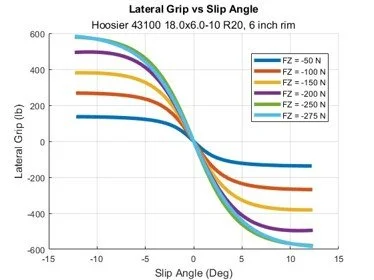
I used MATLAB to compare lateral force, slip angle, normal load, friction coefficient, and cornering stiffness across different tires and operating conditions. The aim was to understand how the tire would behave on the car and how the results could influence setup and future suspension design.
Tire Modelling
The processed data was then used with the Pacejka Magic Formula to create mathematical representations of the tire behaviour.
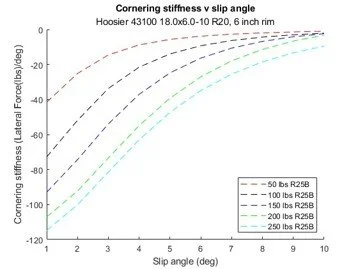
I worked on fitting curves to the experimental lateral-force data and adjusting the coefficients to match the shape, peak force, stiffness, and fall-off of the measured results. This allowed the tires to be compared using a consistent model rather than only individual test runs.
The main lesson was that selecting a tire is not just about finding the highest peak grip. The usable slip-angle range, load sensitivity, cornering stiffness, and how gradually the tire reaches its limit are all important for vehicle balance and driver confidence.
Tire Temperature Sensor Concept
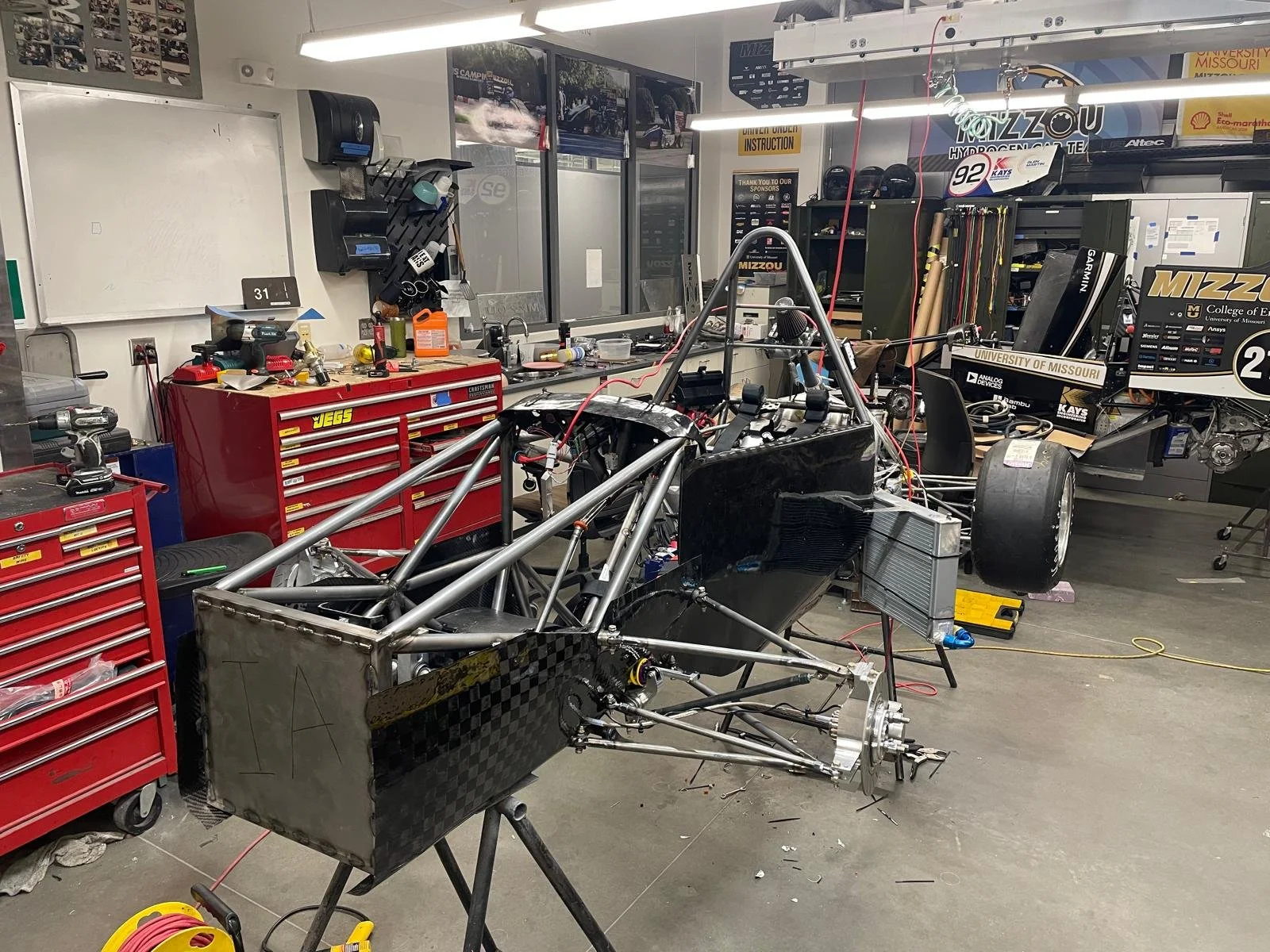
Alongside the data analysis, I worked on a tire-temperature sensor concept for the car. The aim was to measure temperatures across the inner, center, and outer sections of the tread. The sensor would attach to the wishbones and would work for both sides and front/rear wishbones allowing for quick setup during testing days.
The temperature spread could then be used to understand whether the tire was operating evenly and whether changes to camber, pressure, or driving style were required. I also worked on sensor-mounting concepts that would maintain a clear view of the tire while allowing for steering and suspension movement.
The longer-term goal was to compare real track data with the Calspan results and better understand whether the tire was operating within the expected range. This was left for another student to finish as I graduated before completion.
Tire Data Analysis
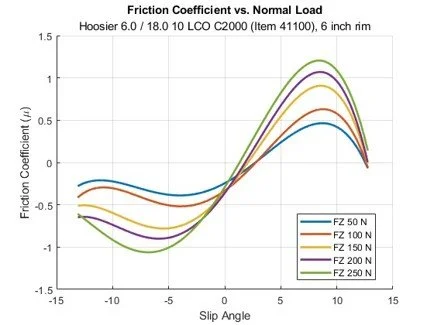
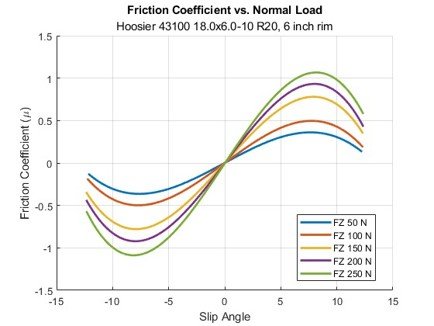
I created MATLAB scripts to clean, organise, and plot the Calspan test data. I compared how the tires generated lateral force at different slip angles and vertical loads, as well as how quickly they built grip.
A major part of the work was understanding load sensitivity. As the vertical load increases, the tire produces more total force, but the friction coefficient decreases. This means doubling the load on a tire does not double the available grip, which is important when considering weight transfer and suspension setup.
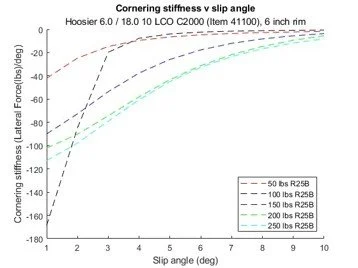
I also compared cornering stiffness to understand how responsive each tire would feel. A steeper initial response means the tire builds force more quickly, while a slower response may feel less direct but more progressive to the driver.
What I Learned
This project was my first proper introduction to tire data and showed me how much of the car’s behaviour comes back to the tire. Small changes in vertical load, slip angle, temperature, or pressure can significantly change the amount of force available.
I also learned how important it is to present complex data clearly. The raw test files contained a large amount of information, but the useful engineering conclusions only became clear after the data was filtered, compared, and displayed in the right way.
The work helped me connect tire behaviour with suspension design, weight transfer, vehicle setup, and what the driver may feel on track.
Project Outcome
The project developed an initial MATLAB workflow for tire analysis within Mizzou Racing and provided the team with a clearer way to compare different tire options and operating conditions.
It also gave me a strong starting point in tire modeling and helped shape my interest in vehicle dynamics, setup analysis, and performance engineering.
Skills and Software
Tire Analysis
Lateral Force | Slip Angle | Cornering Stiffness | Load Sensitivity | Friction Coefficient
Modeling and Data
MATLAB | Pacejka Magic Formula | Curve Fitting | Calspan TTC Data | Data Visualization
Vehicle Development
Suspension Setup | Tire Temperature Analysis | Sensor Mounting | Engineering Interpretation