
Damper Selection for OBR26
Project Overview
As part of a three-person vehicle dynamics team, I worked on selecting the damper specification for the 2026 Oxford Brookes Racing car.
We created a simulation-based selection process using suspension calculations, Adams models, MATLAB analysis, supplier damper curves, and contact-patch-load results. The aim was not simply to choose the stiffest damper, but to find the best balance between body control, tire contact, stability, and response over curbs and higher-frequency road inputs.
My Contribution
I worked mainly on the modeling, simulation, and interpretation of the results. This included calculating suspension characteristics, reviewing natural-frequency and damping-ratio targets, analyzing Adams outputs, and comparing the available Multimatic damper curves.
I also helped bring the different parts of the project together and explain the engineering reasoning behind the final recommendation. As this was a three-person project, we divided the modeling and analysis tasks before comparing our findings as a team.
Natural Frequency Analysis
The first step was to understand the suspension’s basic behavior. We used the car mass, spring rates, motion ratios, and unsprung mass to calculate the wheel rates and natural frequencies.
These calculations gave us a starting point for understanding how quickly the car would respond and whether the spring and damper combinations were appropriate. We then compared the hand calculations with 2-DOF and 4-DOF models to check that the results remained consistent as more vehicle behavior was included.
This stage showed that natural frequency is useful for defining the operating range, but it cannot select the damper on its own. The damper still needed to be evaluated at different shaft speeds and under varying road inputs.
Low-Speed Damper Analysis
Low-speed damper behavior mainly affects how the car responds during braking, cornering, and acceleration, as well as during slower weight transfer.
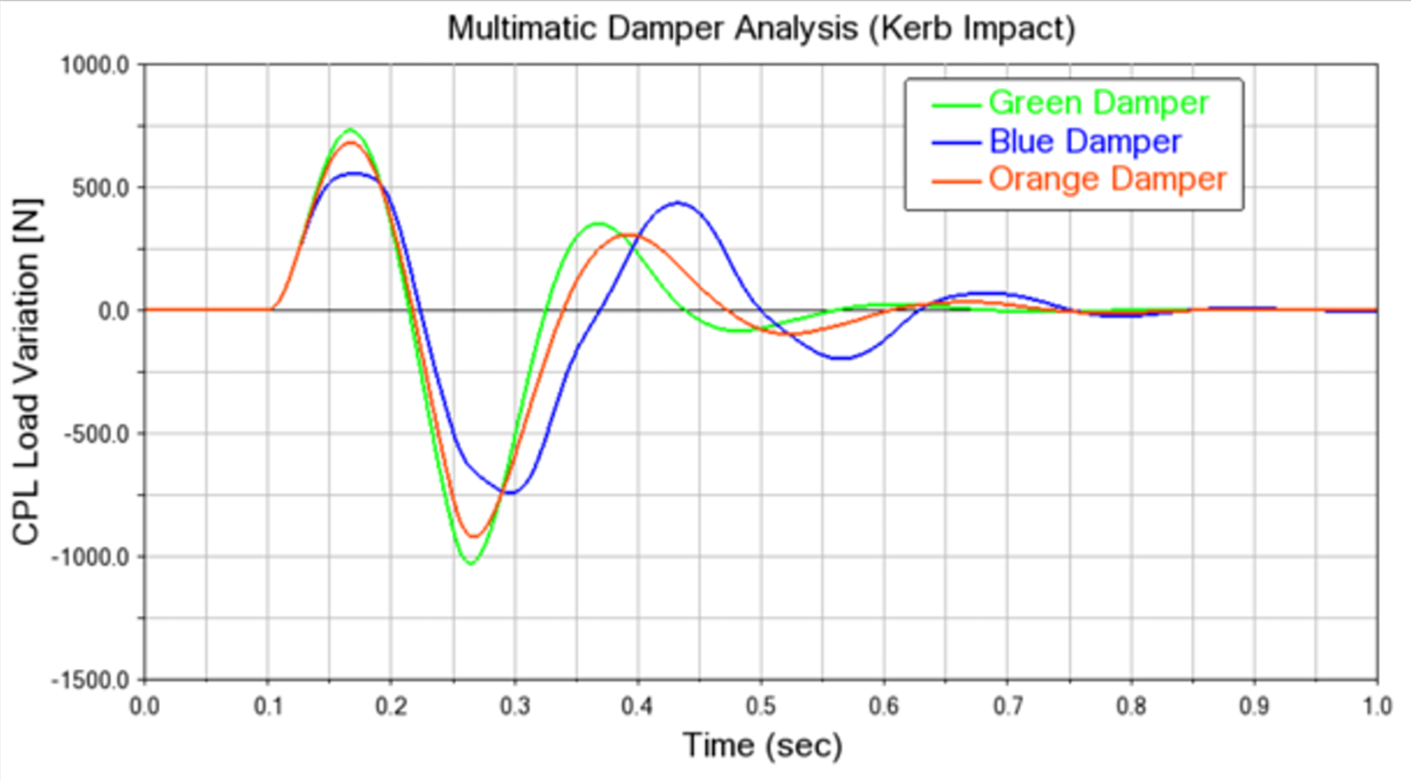
The available damper curves were compared in MATLAB to understand how much force each option produced at lower shaft velocities. We also reviewed the damping ratio and contact-patch-load variation to see how each damper controlled the body without creating unnecessary load changes at the tire.
This highlighted an important compromise. More damping can improve body control and make the car respond more quickly, but too much can reduce mechanical grip and make the car less compliant.
High-Speed and Kerb Analysis
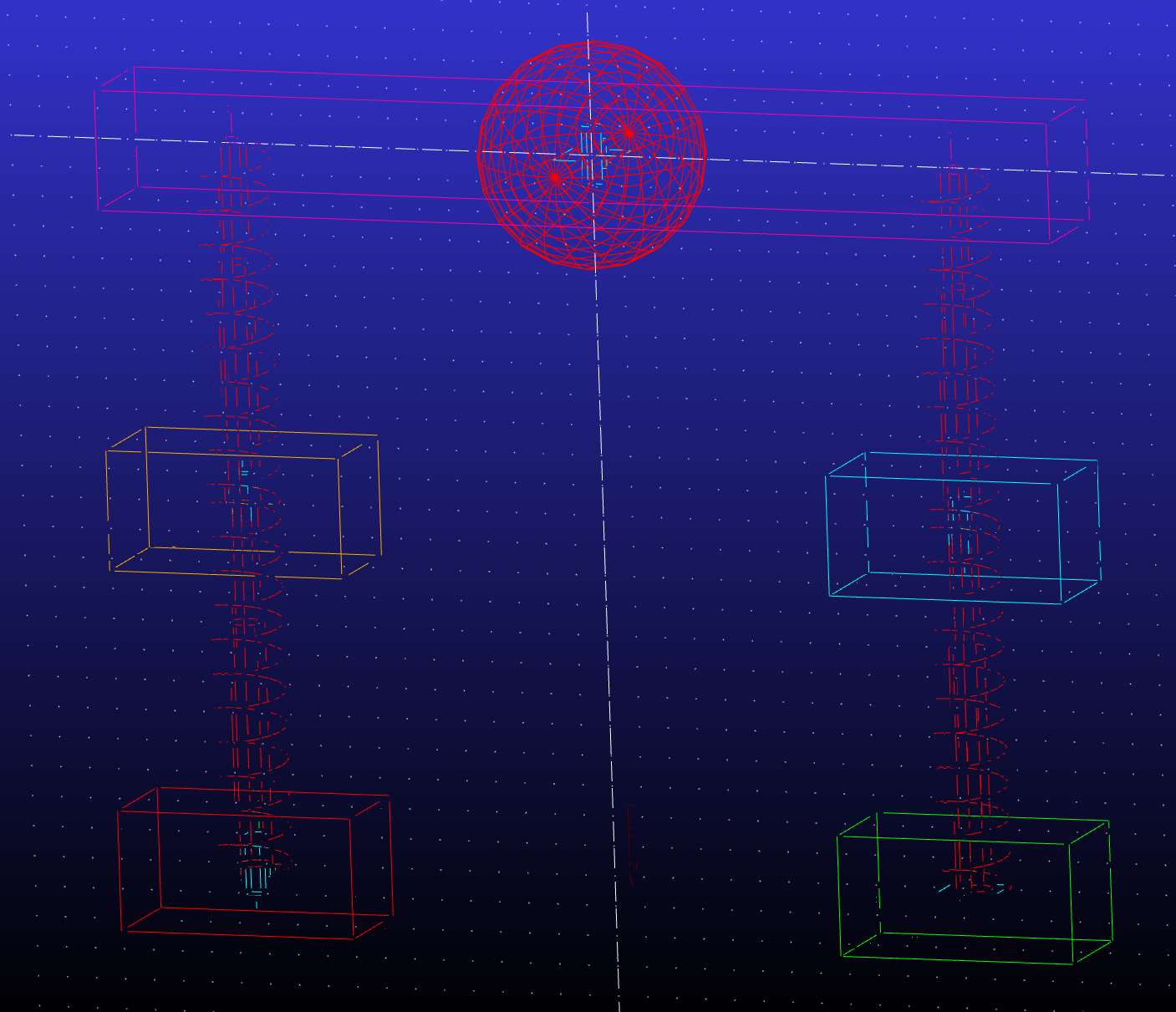
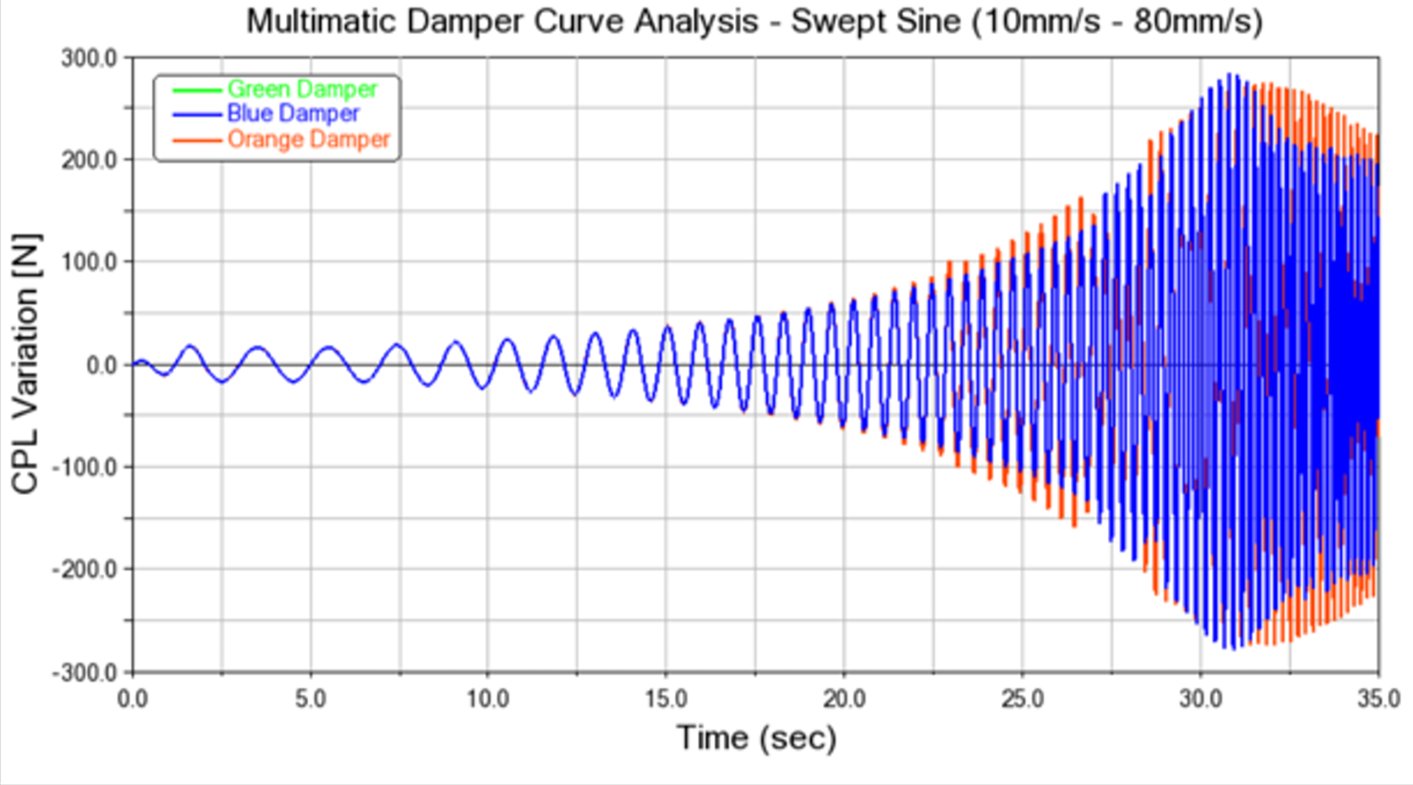
The dampers were then evaluated under faster inputs, including swept-sine tests and a simulated curb strike in Adams.
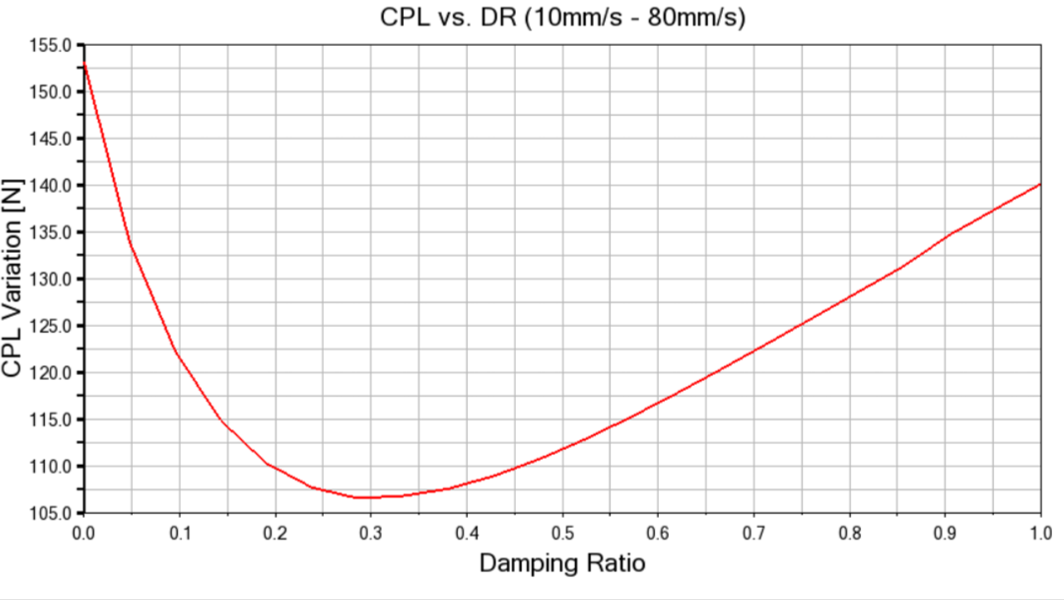
For the curb analysis, we compared the initial peak load, the size of the following oscillations, and how quickly the contact-patch load returned to normal. This helped show how each damper would respond to a sudden input, rather than only to steady-state suspension motion.
The results showed that the damper with the best low-speed control was not automatically the best over a curb. A damper that reacts too aggressively can transfer a larger load into the tire, while a softer response may take longer to settle. The final choice, therefore, needed to work reasonably well across both situations.
Final Damper Selection
The final recommendation was based on all the results rather than on a single graph. We considered natural frequency, damping ratio, low-speed body control, higher-speed response, contact-patch-load variation, and curb performance. Thus, the conclusion was the blue damper as seen in the plots.
No single damper was the best in every test. The selected option provided the strongest overall balance and gave the team a suitable baseline that could still be adjusted through damper settings and future vehicle testing.
This was one of the main lessons from the project: engineering selection is normally about finding the best compromise for the full vehicle rather than simply choosing the option with the highest or lowest value.
What I Learned
This project gave me a much better understanding of how dampers affect more than just ride comfort. Their behavior changes the rate of weight transfer, the amount of body movement, how the tire remains loaded, and how quickly the car settles after an input.
I also learned how important it is to look at the same problem using more than one method. The hand calculations provided a simple baseline, while the Adams and MATLAB models allowed us to investigate behavior that was harder to see from the equations alone.
The project also improved my ability to interpret results rather than only produce graphs. Some options looked better in one test and worse in another, so the main challenge was understanding which results were most important for the car and explaining the reasoning behind the final choice.
Project Outcome
The project produced a data-driven damper recommendation based on the car’s mass, suspension geometry, spring range, natural frequencies, damper characteristics, contact patch load behavior, and curb response.
It gave the team a clear technical starting point for the OBR26 car and a process that can be updated as more accurate vehicle data and physical testing become available.
Skills and Software
Modelling and Simulation
Adams | MATLAB | 2-DOF and 4-DOF Suspension Models
Vehicle Dynamics
Damper Analysis | Natural Frequency | Damping Ratio | Wheel Rate | Contact-Patch-Load Analysis
Engineering Development
Data Interpretation | Technical Comparison | Design Decisions | Team Collaboration